April 15, 2010

بكم? - dinner...


Come and get it boys, dinner is served! Contents include: big ol' bowl of koshari and marinara sauce, two packs of strawberry flavored wafers, and a liter of cola. Now that's a paper-writing meal right there.

Just to refresh your memory, $1 equals about 5.4 Egyptian pounds. Whoever is closest without going over will be the winner, and they'll receive some trinkets from foggy old Jerusalem town. Guess away.

April 13, 2010

No, they don't just hand out A's here...

A lot of people think a semester abroad is a time to slack-off and relax, as the academic standards of the host university usually aren't up to par with ND's. Admittedly, this allegedly diminished and less challenging workload was something I was looking forward to. However, if what I've got in store for me over the next five weeks is any indication, this type of thinking needs to be done away with It looks straight up Tough with a capital T. So here's what's facing me head-on (and no, I haven't started on any of it).
  • A 3,500 word research paper for International Relations in the Middle East (due May 5)
  • A 3,500 word research paper for Comparative Politics in the Middle East (due May 5, as well)
  • Two 4 page reading responses for Women, Islam, and the State (one due this Thursday, one due in two weeks)
  • An outline and annotated bibliography for my final paper for Women, Islam, and the State (due next Thursday)
  • A day of leading class discussion in Women, Islam, and the State (sometime in May)
  • A 15 page research paper for Women, Islam, and the State (due May 20)
  • Four final exams (IR in the ME, CP in the ME, Modern Standard Arabic, and Egyptian Colloquial Arabic)
As you can see, not quite the walk in the park I was expecting. While I guess I'm not complaining about the workload (after all, this is college), I'm still pretty surprised. From what everyone's said, studying abroad, particularly at AUC, was a piece of cake. I'm quickly learning that may not be the truth.

Still on the list...

Well, in case you haven't heard, I received a grant from Notre Dame that will allow me to prolong my stay out here in the Middle East. I'll be taking part in an intensive Arabic program this summer in none other than Cairo. Should be home in early August. But I'm sure I'll talk more about all this later.

Anyway, with an extra two months out in this neck of the woods, my opportunities to travel have just expanded immensely, especially considering the fact that I have three weeks in between the end of the spring semester at AUC and the beginning of my summer program. That's a lot of time that needs to be killed. Here's a brief collection of destinations I'd still like to cross off my list before I head back to the Land of the Free:

 Alexandria, Egypt: Located only two hours away from Cairo, Egypt's second biggest city offers a discernible change of pace from the country's hectic capital. Although the seafood the city is renowned for isn't likely to suit my fancy, I'm sure I'll be content with the Roman ruins, the Qaitbay Citadel, and just the refreshing Mediterranean air. I'll probably make my way up there over a weekend in the summer.

Luxor, Egypt: Luxor is an absolute treasure trove of ancient Egyptian wonders. You need at least three days just to scratch the surface. It's a bit of a trek (10 hours by train, straight south from Cairo), but I plan on getting down there sometime later this month. And the sooner the better- it's supposed to be 110+ F in the summer months.

Dahab, Egypt: When the summer heat rolls in, I can think of nothing more appealing than a get-away to the lazy Red Sea resort town of Dahab. It may not have the glitz and the glam of Sharm al-Sheikh, but that's really not what I'm looking for. A few days of swimming, snorkeling, and plain and simple relaxation are all I need. A celebratory trip to Dahab (which means "gold" in Arabic) appears to be in the cards following the end of classes.

Mount Sinai, Egypt: Located smack dab in the middle of the arid and rugged Sinai Peninsula, legend maintains that this is the location where Moses received the Ten Commandments. Regardless of the merits of this claim, the sunrise from Mt. Sinai is supposed to be quite a spiritual experience in its own right. I'll probably make my ascent on the way back from Dahab to Cairo.

Istanbul, Turkey: Well it didn't look like I was going to be able to fit Turkey in, but now that I'll be in the area until late July, I really have no excuses. I'm not sure what all I'll be able to see in Turkey (it's a massive, fascinating country that you'd probably need to spend a few weeks in to do it full justice), but Istanbul is definitely a necessity. Simply put, there is no other city in the world quite like Istanbul. It is the only city to straddle both the European and Asian continents. It has served as the crown jewel of the Byzantine Roman Empire, the Ottoman Empire, and is currently the cultural and social capital of one of the Middle East's most powerful players. Only decades ago, it was the seat of the Islamic Caliphate, but now is championing Turkey's push for admittance into the European Union. Caught somewhere between the East and the West, Christianity and Islam, and antiquity and the future, Istanbul is one of the world's most fascinating places. I'm planning a trip in early June.

Kurdistan, Iraq: What! I want to go to Iraq? But isn't there a war going on there? Isn't it ravaged and unsafe? Isn't travelling there a death wish for any white-skinned American? Well, perhaps partially true. Much of the country is highly volatile and dangerous, completely unsuitable for travel. However, the same cannot be said for region in the northwest that's controlled by the Kurdish Regional Government. Since the '91 Gulf War, this area has been essentially an autonomous country, only loosely affiliated with Baghdad and the rest of Iraq. While the rest of the country fell into chaos following the aftermath of the 2003 invasion, Kurdistan remained relatively calm and tranquil. "The Other Iraq," as it's happily referred to by locals, has undergone a bit of a boom in recent years and now has an emerging tourist economy. The draw for me is the area's beautiful natural landscapes, as well as the simple fact that I'll be able to say, "I've been to Iraq." I'm thinking about working a visit to Kurdistan in as part of my trip to Turkey.

April 11, 2010

Is that a sandstorm or are you just happy to see me...

This morning, as the bus that shuttles us to school plodded its way through Cairo, I took a peak out the window at the urban sprawl around me. This in and of itself is a bit of a novelty; normally at this point in my day, I'm asleep with my head uncomfortably resting on the back of the seat in front of me, attempting to milk the hour long bus ride for all the sleep its worth. But today, I had to cram for an Arabic midterm that I had, of course, neglected to study for the night before, and was therefore wide awake.

The view outside my window was one I had grown accustomed to: ungodly amounts of traffic, alternating between a crawling pace and pure, unadulterated stagnation; the sea of faded gray and tan, flat-roofed buildings, as far as the eye can see; and, of course, a thick layer of all-enveloping smog.

Yet today, the smog seemed even more suffocating than usual. I thought this could be attributed to even higher levels of air pollution (which, honestly, would seem impossible; I already feel like I'm living inside factory smoke stack), but as we made our way further and further away from the downtown area and the heaviness in the air still hadn't begun to recede, I knew something else was up.

When I stepped off the bus, my answer hit me in the face- literally. A healthy mix of sand and dust, borne by the wind, pelted my skin. Soon my eyes and mouth began to feel the effects and I was forced to turn my back to the on coming tirade. Al-Khamsin had arrived.

Al-Khamsin is a dry, dust-bearing wind that sweeps across North Africa every spring. Its name is derived from the Arabic word "خمسين",  which means "fifty," the length of time the wind generally blows. Although it's usually nothing too bad, just some sand here and there, I've heard that it can get so bad on occasion that the sun becomes completely blotted out and you can't even see your hand in front of you.

The sand and wind seemed to die down as the day went on, but somehow a significant amount managed to subtly sneak in through my mouth, causing irritation to an already sore throat. If the untold amount of air pollution in Cairo didn't provide a good enough reason to keep your mouth firmly closed when walking around town, getting a mouthful of sand and dirt certainly seems like a strong compelling factor.Oh well, only 49 more days of this (khamsin, that is).

April 10, 2010

Putting spring break to rest...

Well, I am now officially back in the swing of things here in Egypt's capital. I completed two days of school, had four servings of koshari in less than 72 hours, and spent an entire day doing nothing mention-worthy. Man, it's good to be back!

Anyway, I'm going to do one last post reflecting on where I've been over the past two weeks and what I've been up to, before finally closing that chapter and moving on. But rather than do a big write up, I'll make it a little easy on the eyes and whip up some lists. So without further ado, I present to you the highs, the lows, and everything in between of Spring Break '10.

The Five Best Food Items

  1. Kafta wraps from University Sage, Beirut: located right across from the beautiful AUB campus, University Sage is one of many tasty eateries that line Bliss Street. It sets itself apart with its hearty, delicious, and fairly cheap (2500 LL = $1.65) kafta wraps. We had them on three occasions during our time in Beirut.
  2. Soft serve on the streets of Aleppo: Walk through the streets of Aleppo, and it's hard to go more than a minute without spotting a vendor whipping up soft serve vanilla ice cream. Though it wasn't anything exotic, it was a sweet little snack on the very cheap side (5 Syrian pounds = $.10)
  3. Chocolate filled croissants in the Old City of Damascus: While on our way to a minibus station, we stumbled across a bakery serving fresh goodies straight from the oven. The pastry itself was quite good, but tack on the fact that its warm and fluffy and the chocolate is gooey and at 10 Syrian pounds you've got yourself a winner.
  4. Ice cream from Bliss Street, Beirut (pictured): Just a few meters away from the kafta wraps of University Sage was some of the most decadent and delicious ice cream you'll ever see. Of course, since it was on our way back to the hotel and we'd just finished dinner, we had to stop and indulge ourselves frequently.
  5. Pizza bread Damascus's Old City: These mini-pizzas, coming in cheese, veggie, and meat varieties, were the perfect option for a light afternoon snack. At 15 Syrian pounds (= $.30) a piece, one could afford to get a few.
The Three Worst Places Stayed In
  1. The New Swedish Hostel, Jerusalem: The only thing Swedish about this place was the name, unless you consider grumpy staff and bathrooms with ceilings so low you can't use them to be Swedish. I understand that prices go up during the Easter season, but charging $22 a night for a bed in a 16 person dorm is blatant piracy.
  2. The Regis Hotel, Beirut: The Regis was actually the nicest hotel we stayed at; it was also the most expensive. It was nice having free internet (when it worked), but the apathetic, impatient, and irritable nature of the young man who ran the place was a major turn off. Plus, the bathroom always flooded whenever the shower was used.
  3. Al-Rabie Hotel, Damascus (pictured): At Al-Rabie, you get what you paid for. In our case, that happened to be a roof top bed. While the building itself was very nice and had a cozy little lounge downstairs, between the cold and the calls to prayer, roof-sleeping was a pretty uncomfortable and inadequate experience, at least for the first night. 
The Nine Most Favorite Attractions 
  1. Crusader castle/Roman ruins of Byblos: Perhaps it was the picturesque Mediterranean backdrop or the fact that we had the whole place to ourselves for a couple of hours, but I absolutely loved Byblos. It may not have been quite as expansive or awe-inspiring as some of the other sites, but I explored every nook and cranny of it, doing my best Nathan Drake impression along the way.
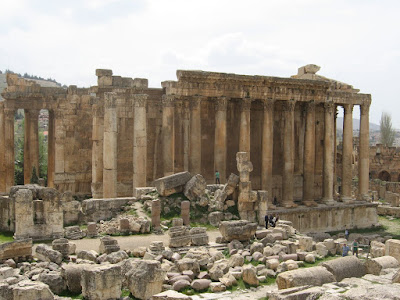
  2. Baalbek's Roman ruins: Maybe my ignorance of all things Roman is to blame, but I was simply dumbfounded by what I saw in Baalbek. Not only was the number of ruins impressive, but the sheer size of some of them was astounding. I've said it once, but I'll say it again, if you want to see good Roman ruins, come to Lebanon.
  3. The Church of the Holy Sepulcher in Jerusalem: Attempting to explain this place is a futile endeavor. Simply put, it gives off an ambiance that no other place in the world can match. Its hodge-podge assembly, dimly lit corridors, and embarrassment of holy sites leaves those who enter bewildered and taken aback, but undeniably imbued with a sense of awe. Truly one of the most bizarre and mystifying places I've ever set foot in.
  4. Petra (pictured): The admission fee at Petra is pretty steep (33 Jordanian dinar = $46). However, since it's entered the ranks of the new Seven Wonders of the World, I suppose its earned the right to be overpriced. And it's not like we didn't get our money's worth: we spent a whole eight hours hiking and climbing. While the ancient structures weren't as numerous nor as impressive as I thought they'd be, the natural beauty of the landscape was worth it. It was if an artist's palette of a multitude of reds, oranges, yellows, pinks, and browns had been carelessly spilled on the barren rocks, without any rhyme or reason.
  5. The Krak des Chevalliers- The Krak is the absolute epitome of a childhood fantasy castle. It's massive, it's foreboding, it's perched amongst the clouds atop an barely-scalable mountain.The passages inside the castle were vast and provided us with ample ammunition for exploring. However, the fact that they were shooting a film there, and the place was littered with cheesy Pharonic-themed set pieces was a bit of a detraction. Nonetheless, the view of the castle cast against a cold, gray sky was priceless, and provided me with a mental image I won't soon forget.
  6.  Jeita Grotto: Nestled in the valleys of the Mt. Lebanon mountain range, the Jeita Grotto is a startling place of natural beauty. Here you'll find rock formation formations of every shape and size, each individually molded by time and the steady drip of water. Inside, it felt like walking through some type of Gothic-style cathedral one would encounter in a dreamworld. Not being allowed to take pictures kind of stunk, but the boat ride in the submerged lower cavern was certainly a highlight I don't need visual documentation to remember.The 
  7. Aleppo Citadel- "Duh-duh-DUN...dun-dun-dun!" That tune, straight out of Lord of the Rings, was instantly playing in my head the second I saw the Aleppo Citadel's epic ramp.Stretching across the now-empty-moat to the citadel's gatehouse, it's no wonder enemy forces were never able to penetrate this fortress atop a man-made plateau. 
  8. The Ummayid Mosque in Damascus: The Ummayid Mosque is a sprawling complex, easily the biggest and most impressive mosque I've been to yet. The art work that adorns its courtyard, over a thousand years old, depicts simple daily but in an ornate fashion. It also doesn't hurt that the mosque is home to the final resting place of none other than Salah al-Din, as well as the Prophet's grandson, Hussein, and the head of John the Baptist.
  9. The National Museum of Beirut - Simply put, one of the best museums I've ever been to. The extent of its of collection of Roman sculptures and artifacts was impressive, yet the museum wasn't cavernous enough to lose a sense of approachability and warmth. I would've loved to see what wonders it housed before the Lebanese civil war.
The Six Lowest Low-Points
  1. No Escape from Israel: We were feeling pretty good about skipping out of Jerusalem a day early and getting back to Egypt in time for a day of rest and relaxation before classes resumed. We'd been traveling for 12 days at this point and were ready to be done. When we learned that no public transportation would be active the next day because of Shabbat, I was honestly distraught. In the end, we did manage to make our way back to Cairo (expensively), but at that moment when I thought we were stuck in Jerusalem for another day I was at my lowest point since being over here in the Middle East.
  2. Stuck in Karak/Missing Jerash: We had a fool-proof plan devised to see both Karak and the Roman ruins of Jerash in one day. Unfortunately, we didn't account for transportation alterations due to it being a Friday. As a result, we ended up waiting on a bus in Karak for over two hours before it even began moving. Not only did we not see Jerash, but we didn't get back to Amman until after most of its attractions were closed as well.  
  3. Dinner at Kababji:  It was our last night in Lebanon and we thought we'd celebrate a little by taking it easy and going to a sit down restaurant, Kababji. The place looked nice, but not too expensive. They had "platters," which, although at 15000 LL were a lot more than we typically paid for food, sounded pretty filling. They ended up being entirely inadequate, a reality that stunk even more considering filling kafta wraps for a sixth of the price were right around the corner. It may sound a little silly, but we beat ourselves up for
  4. The Days after Petra: Not going to lie- Petra ravaged our bodies. Apart from the damage done to our joints and muscles from the grueling eight hours of scaling mountains and climbing over ruins, our skins was in serious distress after being exposed the the hot Jordanian sun sans any protective ointment of any kind. This one day of severe exposure had long-lasting ramifications: I got tired more easily, was constantly itching, and experienced sharp pain whenever anyone touched my shoulders or neck. My skin is still peeling.
  5. Lost in Beirut:We'd enjoyed a pretty productive afternoon getting acquainted with beautiful city of Beirut. But as night set in, we ran into some complications returning to our hotel. After walking for an hour in what we hoped was the right direction, we made the mistake of thinking we were home free after coming across a familiar landmark. However, one wrong turn took us at least a half hour out of our before we came to terms with the fact that we were lost. I'll never forget opening the book after we learned we were at the Pigeon Rocks, locating ourselves on the map, and wondering How the heck did we end up here?
  6. Complications at the Airport:Being detained at the Beirut airport for 45 minutes was no way to begin a trip. It turned out to be just a minor bump in the road, but at the time, I was scared our entire two-week vacation was about to be derailed.


    The Four Greatest Surprises/Disappointments Encountered
    1. Syrian Hospitality (pictured): Our Lonely Planet guide book certainly didn't lie: the people of Syria were warm and inviting. Whether it was the man who tried to give us his sandwich in Aleppo or the worshipers at a Damasucs mosque who practically dragged us inside to observe their celebration of the Birth of the Prophet, Syrians demonstrated a kindness that you wouldn't expect from the rap their country gets back in the US. While I definitely feel that the Syrian government is anything but peaceful and harmless, the Syrian people certainly deserve a classification of their own.
    2. Israeli Craziness: It should probably be expected around Easter time, but Jerusalem was bonkers. It wasn't really the sheer amount of people rushing to and fro- I was actually expecting that. Rather it was the absurd expensiveness, the irritating street vendors, and the over-zealous commercialization of spiritual sites. Plus, shutting down the entire country on Shabbat was a little irritating. I understand you've got your religious tradition, but seriously...can't the Muslims or Christians drive the buses at least?
    3. Middle Eastern Diversity: It was extremely refreshing to see that no city we traveled to was like Cairo. In fact, no two cities we traveled to were the same at all. Beirut was highly swank and cosmopolitan, Damascus was stately and vibrant, while Aleppo was charming and calm. Each place had its own distinctive feel to it, and each gave off a different vibe. A pleasant surprise to find that not every Arab city is noisy, polluted, chaotic and full of professional scam artists. Which leads me to...
    4. Epytian Scamming: You mean to tell me that despite the fact that I'm a student in your country, I've already paid $30 for visas on two separate occasions, and I'll be living in your borders for the next four months, I have to pay a 75 LE entrance fee? While this was certainly a disappointment, it shouldn't have been a surprise- Egypt is more or less the land of the scam.
    Well that's that. Funny how I chose to write in list-format to avoid excessive writing and then end up sitting at my computer for two hours. Oh well.

    My two week journey through Lebanon, Syria, Jordan, and Israel was an amazing adventure, one unlike any I will ever experience again. There are some things you can only do when you're young and carefree and I think this was one of them. I made some memories and saw some things that I won't soon be forgetting

    Before wrapping this up, I want to give a final shout out to my partner in crime, Mr. Benjamin Michael Gavel. Simply put, if I had gone with anyone else, this trip just wouldn't have happened. Ben and I had the exact same goal in mind: to see as much as we possibly could, as cheaply as we possibly could. And boy did we live by that mantra: we slept in dumps, took public transit everywhere, ate almost exclusively from street vendors, woke up by 7 am almost every morning, walked whenever the opportunity presented itself, and beat ourselves up for days when we mismanaged time or over-paid for food. It was an ironclad partnership founded on shared desires and mutual respect, which saw its way through plenty of tight spots and rocky passes, but no worse for the wear. There were times when I felt like slowing down or taking a day off, but Ben pushed me to press on and I like to think I did the same for him. We both helped each other to get the most out of the experience and had a great time while doing it.

    So as corny as it sounds, not only did I have a heckuva trip, making oodles of memories that will last a lifetime, but I also forged a battle-tested friendship along the way. Not too shabby.
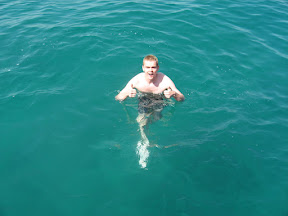
    In case you're wondering, this is my happy face in pictures. I actually do like the guy.

    April 06, 2010

    If a picture is worth a thousand words...

    ...then I wrote about a 1,452,000 word essay over the past two weeks. After being thwarted by crappy internet connections in every city not named Beirut, I've finally been able to upload my pictures from the rest of the journey. Click on the pictures below to see the rest of that particular album.

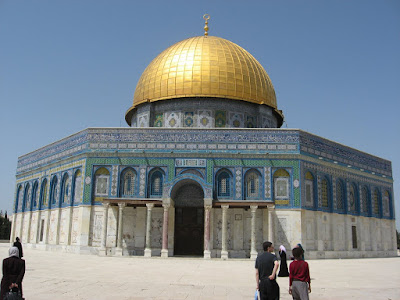
    The Beautiful Dome of the Rock, Islam's third holiest site, located on the Temple Mount in Jerusalem
    The expansive view from the crusader castle at Karak.

    A cliff-side temple from the ancient stone city Petra

    Escape from Israel...

    You know you're glad to get out of a place when the thought of Cairo and all its traffic, noise, pollution, and scams is not only stomachable, but actually evokes a feeling of longing. Yet that's the way I felt after a couple of days in Israel and the Holy City of Jerusalem.

    Let's start from the beginning.

    On Holy Saturday, April 3, Ben and I were in the middle of a familiar routine: waking up at the crack of dawn (oh wait, I actually didn't go to bed the night before, so I guess I didn't do any "waking up") in order to catch a bus to a new and exciting city. We had spent the past three days in Amman, and although Petra was quite a spectacle and the crusader castle at Karak was all fine and dandy, we were a little disappointed with our time in Jordan. We had spent far too much money in the relatively expensive country, had gotten thoroughly scorched and broken down while hiking for eight hours in Petra, and had missed visiting the Roman ruins in Jerrash on what turned out to be a highly unproductive Friday (we spent two hours sitting in a bus- that was not moving...enough said). We were hoping Israel would provide some invigoration and a fitting finale to our two week journey.

    We took a 7 am bus from Amman to the King Hussein/Allenby Bridge border crossing. Here we transferred buses and were shuttled across to the Israeli side, and prepared to be processed (I love the sound of that). Similar to the mystique surrounding crossing into Syria, there is a lot of hype and hysteria surrounding entrance procedures at Israeli borders. For starters, there's the whole deal about getting the dreaded "stamp of death." Basically, because Israel is considered a state enemy of several Muslim majority countries (Iran, Lebanon, Syria, Indonesia for starters), the presence of an Israeli visa stamp in your passport will prevent from gaining admittance into any of them. Apparently you could ask to get your visa stamped on a separate piece of paper, but there were tales of custom officers either ignoring your request or "forgetting" and stamping your passport "accidentally."

    And before you could even think about worrying about the visa itself, you had to pass through security. This was considered an especially difficult task if you'd visited Arab countries beforehand (ding ding ding!). There are stories of people being detained and grilled for hours at the border and others being rejected for no apparent reason. Needless to say, I was a little nervous as we made our way into the facility, especially with my passport chalk full of Lebanese and Syrian stamps, as well as the fact that I had in my possession a book that featured Mahmoud Ahmadinejad and King Abdullah shaking hands on the cover.

    The process itself wasn't too bad- probably only forty five minutes in total. Nonetheless, there were a couple of disconcerting moments. For one, seeing a teenager wearing plainclothes- a nice green polo and some khakis if I recall correctly- and shouldering a decked out M4 assault rifle definitely is cause to pause. Another image, or rather experience, that messed with my mind was being grilled by teenage girls, who serve as Israel's primary custom agents. I came away from that feeling a little vulnerable and confused. But whatever. We were through, and on our way to the holiest of holies, Jerusalem.

    We settled into the little shuttle that would be taking us to J-town. During the 25 minute drive, we struck up a conversation with an interesting French woman who has been traveling away from home for three years and apparently believes that sharks are our "friends." Nice, but crazy. After a while, we entered a tunnel leading directly through a cliffy hillside. When we emerged on the other side, our eyes were drawn immediately to the golden dome of the Temple of the Rock. We were in Jerusalem.

    We got dropped outside the Damascus Gate. Now the real fun began. For some unknown reason, during the the 3+ hours that I had spent on the computer the night before when I was refraining from sleep, I had neglected to find out the location of where we'd be staying, the New Swedish Hostel. I knew it was in the Old City, but after that, well, I wasn't too sure. So without really knowing where we were or where we were going, we entered through the gate and plunged into the madness that is Jerusalem's Old City.

    The streets of the Old City are narrow and crowded, and that's on a good day. The scene that unfolded before was absolute pandemonium. Apparently there was an event that afternoon that everybody and their uncle wanted to attend.Throngs of eager pilgrims mauled anyone who got in their way. Little old ladies clutched at Israeli security personnel and begged them to let them through closings in the street. After a few minutes of trying to deal with the insanity, Ben and I concluded that it'd be a good day to check out some of the sites outside of the Old City walls.


    We headed out the Jaffa Gate, walked around the outer wall and eventually came to Mt. Zion, where the featured attractions included King David's Tomb as well as the room where Jesus and his disciples broke bread in the Last Supper. After that, we set out for the Garden of Gethsemane on the Mount of Olives, where we saw the Church of All Nations, caught an outside glance of the Cathedral of Mary Magdalene, and put ourselves in good position for some panorama views of the Temple Mount and the rest of the Old City opposite us.


    We headed back in to the Old City, where things had calmed down a bit. I was about ready to collapse. I hadn't slept the night before, and climbing up hills in the scorching heat with pre-existing sunburn was not the ideal remedy. I contemplated taking a nap, but decided to man up and see what else we could do that night. We looked for some food, but almost everything we found was absurdly overpriced, at least by Middle Eastern standards. We were about to go hungry until we ran into a hole-in-the-wall establishment serving kebab sandwiches for a somewhat reasonable 8 shekels (conversion rate is 3.7 shekels to a dollar, so a sandwich was about $2.20).

    We returned to the hostel after eating. It came to our conclusion that staying in the overpriced hostel in the midst of this overpriced city was probably not the best way to end what had been an extremely frugal trip, so we canceled our reservation for Monday night. The plan was to leave Monday and get back to Cairo with enough time to get things together before classes started on Wednesday. Sounded good.

    As for the next day, Easter Sunday, we had planned to wake up early in the morning, check out the Temple Mount, and then make our way to 10:30 Mass at the Church of the Holy Sepulcher. However, we kept on hearing from everyone and their mother about some amazing service that occurred at midnight. So at 11:30, we headed over to the Holy Sepulcher and checked it out.

    First off, a description of the Church of the Holy Sepulcher is in order. Or rather, an attempted description. It is simply something that cannot described. It is easily the most bizarre, wonderful, strange, odd, baffling buildings I have been in. Calling it simply a "church" doesn't do it justice because it is really so much more. It's a monumental structure of domed ceilings and narrow passages, that gives off the vibe of a crypt or a labyrinth. Ben described it as eclectic, a sort of hodge-podge of a variety of different elements. Its history of construction, destruction, and reconstruction, that spans a thousand years, certainly helps to explain why.

    The Church of the Holy Sepulcher stands today on the spot where most Christian sects believe Jesus was crucified. In addition to this sacred site, the complex (for indeed, that's what it really is) houses several other highly significant relics and holy spots, including the Stone of the Anointing, where Christ's body was prepared for burial, and the Holy Sepulcher itself, the tomb where Jesus was laid after death. Thousands of Christian pilgrims visit it each day to touch or simply view these holy spectacles. We had actually visited a few hours earlier and waited in line for an for the opportunity to enter the Aedicule, where the tomb of Jesus is housed. The building is practically overflowing with relics and shrines, and it probably would've taken a solid couple of days to see them all. Click here to read a bit more about the Church of the Holy Sepulcher.

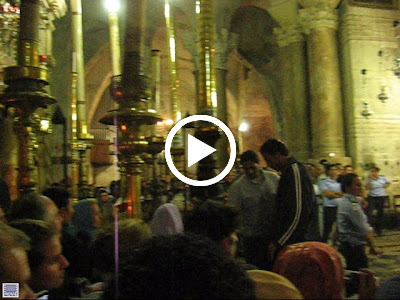
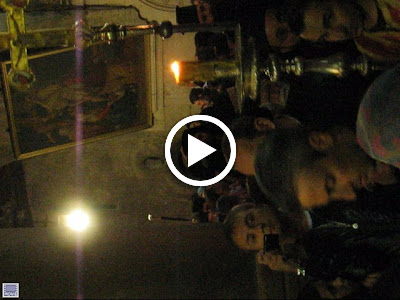
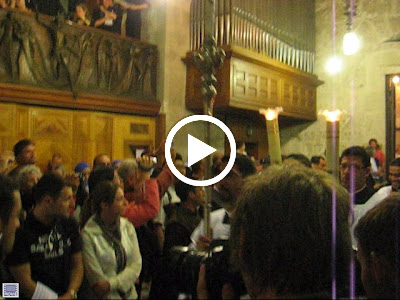
    Anyway, the service, or whatever we attended, was truly fascinating. I'm not entirely sure what went down, but it was quite a sight to behold. A procession of Greek Orthodox, Coptic, Russian Orthodox, Armenian Catholic, and Roman Catholic religious men proceeded throughout the packed quarters to the Aedicule, where some type of traditional ritual was being performed. My senses were overwhelmed as a sea of people pressed in all around me, heavy incense wafted to and fro, candles flickered in the darkness, and the tones of chimes and bells echoed across the domed ceiling.It was a surreal experience. Here's some video footage of what went down.


     I always forget that you can't film things vertically

    After sticking around for three hours with no foreseeable end in sight, we headed back to the New Swedish Hostel and got to sleep. Our plan for the next morning was now slightly altered, and we attended Easter Mass at the Holy Sepulcher, joined by our friend Erin from ND, before anything else. The service was in Latin and the building isn't exactly laid out in a way that is conducive for celebrating Mass with hundreds of people, but it was still an amazing experience.

    After a lunch of candy (not only was it justifiable because it was Easter, but also because it was the cheapest stuff around), we headed to the eastern part of the Old City. We checked out the Wailing Wall (the last remaining remnant of the Holy Temple, where the Holy of Holies resided), and then made our way into the Temple Mount where we snapped some pictures in front of golden plated Dome of the Rock (built on the spot where Muslims believe Muhammad will be ascended into Heaven). It was pretty astounding to think about it: In less than an hour, we had visited some of the holiest sites of the world's three monotheistic religions, all of them within probably a square half mile of each other. Crazy.


    Following our site seeing blitz, we were off to bus station in central Jerusalem to figure out our transportation situation for the following day. Along the way, we talked to some American girls who delivered some horrible news to us: the following day was Shabbat, the last day of Passover for Jews, and a significant national holiday. There would be no public transportation running until dusk. Our best bet would be to hire a private taxi to take us to Tel Aviv, where we could maybe catch a bus south toward Egypt. We hurried back to the Old City where we found an internet cafe that had phone services. We looked up the number for a taxi company, but our worst fear was confirmed: they had closed early for Shabbat. We were screwed. We looked online to see when buses were running, but we wouldn't even be able to get out of Jerusaelm until 8 pm, meaning we wouldn't get to the Israel-Egypt border till early early morning, well before (or after) any buses left for Cairo. Things looked bleak.

    We ran into some other AUC students I knew from class that night, who likewise wanted to get out of expensive,crazy Jerusalem and back to Cairo ASAP. They said they had heard about a bus leaving from Jerusaelm at 8 am for the southern city of Eilat. It sounded too good to be sure. And sure enough, after waking up at 6 am the next day to catch it, it wasn't there. What now?

    Fortunately, we were able to catch a service taxi to Tel Aviv  a little after 8. However, when we got to Tel Aviv, we were presented with another problem: the bus station wouldn't open until 5 pm. Not only did we want to get out of there as early as we could because we wanted to get back to Egypt, but also because we were in what appeared to be Israel's version of a ghetto, complete with impoverished looking minorities and run down buildings. Not an ideal place for five foreigners saddled with luggage to be hanging out.

    We had initially ignored the horde of taxi drivers who wanted to charge us 1000+ shekels for a ride to Eilat ($270 or $54 a person). But after gathering up four others who wanted to travel to Eilat and getting an offer for 900 shekels, we agreed. However, as it turns out, we had agreed to get in a taxi with the driver from hell. The man was insane. He was large and scary and had soulless eyes. I thought at numerous times that he was going to eat me. Other taxi drivers even warned us about going with him, though at the time I dismissed this as jealousy that he had landed the gig.

    When we left the station he demanded payment immediately, something generally unprecedented when taking transportation in the Middle East. When we said we'd pay when we got there, he absolutely flipped out. He spoke no English at all, only really angry Hebrew, so on occasion I'd yell something random at him like "PIZZA!" just for kicks. He actually drove around the block the station was on until we all paid up. We settled in for what we thought could be the last ride of our lives.

    But overall, it was an uneventful trip, aside from stopping in the middle of the highway so the driver could get out and pee, as well as our 15 minute pull over session with multiple police cars (I was convinced he was a mass murderer, would shoot the cops, and then come back to the bus to finish us of). But aside from these detours, the guy made pretty good time.

    We arrived in Eilat at about 4:45, then caught a taxi to the border crossing. There, we were in for a rude surprise: a 98 shekel exit fee. We'd seen some mention of an exit fee in the book, but we weren't really expecting to pay it. Places like Lebanon, Syria, and Jordan had loosely enforced their visa fees, so why couldn't Israel do so for a couple of Americans? Whatever.

    We walked across the border and into Taba, Egypt. Unfortunately, we missed the 4:30 Cairo bus (Cairo is one hour behind Israel) by only a few minutes, so we had to settle for hiring someone to drive us back, and did so for 150 pounds each. But before we left, we were in for another disappointment: a 75 pound entrance fee into Egypt, even though we all had student visas and had been living there for at least two months. Madness.

    The ride from Taba to Cairo flew by. There was one cause for concern, however. At the Suez Canal, we switched vans and drivers. We paid the first driver the full amount and then he gave the second driver a cut of it. So, lo and behold, when we got to Cairo, the driver refused to take us to a metro, as we had been promised, and tried to drop us off in a section miles away from Downtown. He'd already gotten his money, so what did he care?

    One of the girls we were with called an Egyptian friend of hers who came to our rescue and got cabs for us back to our respective residences (we were out of money at that point). Ben and I got back to the AUC dorm in Zamalek sometime before 1 am, and, of course, welcomed ourselves back with a bowl of koshari. It had been a long, tiring, frustrating, and day but at least we were back. However, there was no denying how EXPENSIVE the events of the day had been. Here's a recap, broken down by how much I paid for each service:

    10 shekel cab to the bus station in Jerusalem ($2.70)
    30 shekel service taxi to Tel Aviv ($8.20)
    100 shekel for transportation to Eilat ($27)
    25 shekel for taxi ride to border ($6.75)
    98 shekel exit visa ($26.50)
    75 Egyptian pound entry fee ($13.90)
    150 Egyptian pound ride back to Cairo ($27.75)
    DAY'S TOTAL: $112.80

    What a horrible way to end what had otherwise been an extremely frugal trip. But overall, the trip was amazing, and I will address it in full in the coming days. Israel wasn't that bad I suppose. I think the negative experience there was a factor of being tired and exhausted and in the last leg of our trip. If we'd done it first, we probably would've loved it. Additionally, a lot of the problems, like the complication woes on Monday, were partially our fault for not seriously looking into things ahead of time. Oh well, you live and you learn.

    As I said, I'll be doing some full scale reviews of my trip in the upcoming days. If there is anything at all you want to know (along the lines of What was the best meal you had/favorite site you saw/biggest surprise you experienced? etc, feel free to email me them or leave them in the comment section and I'll to address them.

    April 03, 2010

    Lent is a time of reflection...

    ...and it's almost over. So before Easter Sunday is finally here, I'm going to take a brief moment to reflect (review is probably a more appropriate term but I'm in the Easter spirit!) on my amazing spring break journey thus far. I'll provide links to pictures where available (I have a whole bunch basically from Aleppo onward that I haven't been able to upload yet).

    Tuesday, March 23
    Ben and I woke up in the early morning and caught a cab to Cairo International Airport. A couple of hours later, we were on board an 11:50 Middle Eastern Airlines flight bound for Beirut. After touching down in B-town and going through (the perplexingly challenging) customs, we caught a cab (that was way overpriced) and headed into town. After checking into our hotel we explored the beautiful campus of the American University in Beirut, and then wandered into town as the sun set and got a little lost.


    Wednesday, March 24
    Our classmates back at AUC were still in school, but Ben and I were on to our first attraction. We took some public transportation to Dawra, a circle in Beirut where buses congregate, and were soon on our way north to the Mediterranean town of Byblos. There, we explored a beautiful crusader castle, strolled through the quaint cobblestone streets, and I even took a dip into the beautifully blue sea. A short time after noon, we were on to our second destination of the day: the Jeita Grotto. We caught a bus back toward Beirut and it drop us off at the junction where the road to Jeita began. We caught a cab up the hill and through a valley and were soon at the grotto. The caves inside were truly captivating and its a shame we couldn't take pictures. We finished our time at Jeita with a subterranean boat ride in the lower cave aboard a vessel powered by an electric motor. After that, we said screw the taxi, and walked an hour and half back to the main highway, passing by some of the most gorgeous valley scenery I've seen in my life.


    Thursday, March 25
    We woke up very early and took a taxi to the Cola transport hub in south-side Beirut. From here, we took a minibus east, passing over some of the most treacherous mountain highway I've ever encountered. Our destination was the ancient Roman ruins of Baalbek, located two hours from Beirut, squarely located in Hizbollah territory. Upon arrival in Baalbek, we entered the site and spent the next four hours or so making our way through what certainly must be some of the most impressive Roman ruins in the world. When our sightseeing was over, we grabbed lunch, headed back to Beirut, and prepared for the evening. After a couple of overpriced drinks at a bar called The Blue Note (which charged us a hidden fee of $15 for the live music!) we tried our luck at getting into one Beirut's trendy night clubs, BO18. No luck. Those bouncers were some cold-hearted SOBs.


    Friday, March 26
    On our last day in Beirut, we explored the National Museum and discovered a treasure trove of artifacts and displays. Following our time at the National Museum, we set out in attempt to locate two more, the Robert Mouwad Museum and the Cirsock Museum. After searching for over two hours, we discovered that the Robert Mouwad Museum apparently no longer exists, while the Cirsock Museum was closed due to construction. We used the rest of the day to re-explore downtown Beirut, including its posh shopping areas, fancy eateries, as well as the imposing Al-Asin Mosque and its neighbor, St. George's Maronite Cathedral. After this, we rested up in preparation for the unpredictability that the next day held.


    Saturday, March 27
    Ben and I were at the Charles Helou Bus Station in time to catch a 7:30 am departure bound for Aleppo, Syria. When we reached the border some three hours later, the bus went on without us as we were left to deal with the Middle Eastern tourist rite-of-passage that is acquiring a Syrian visa at the border, something technically not allowed. However, the process was fairly painless, and only took three and half hours, certainly less than the five we had been anticipating. Once on the Syrian side, we caught a minibus to Homs and then a bigger bus to Aleppo. It was dark and rainy when we arrived, but nonetheless, after checking in at our hotel, we started exploring, a move that proved fruitless until we realized we'd been interpreting our map wrong for the past hour.

    Sunday, March 28
    Sunday was an all-day Aleppo day. We began with a visit to the plateau-topping Islamic citadel, an impenetrable structure with a single bridge for an entrance that evoked images from Lord of the Rings. After this, we explored the medieval bazaars of Aleppo, the Great Mosque, and then followed it up with a healthy does of churches in the Christian Quarter, most of which were unfortunately closed.

    Monday, March 29
    Our final destination for the day was Syria's capital of Damascus, but before that, we had an important detour: the legendary crusader castle known as Krak des Chevalliers. We took an early morning train from Aleppo to Homs and then caught a bus to Krak. We spent the next three or so hours exploring the massive structure. It was a bit cold out, but the gloomy skies added to the mystic of the place, and gave us a sense of foreboding that must would-be-siegers had to have felt when approaching the castle. Following Krak, we went back to Homs and then to Damascus. Night began to set in as we briefly explored this unfamiliar city, but we had an extremely memorable night. A visit to St. Anthony's Catholic Church yielded a meet and greet with Father Mark, a Spaniard who actually used to preside at the church I attend every Sunday in Cairo. Another exciting religious experience soon followed, as we were invited into a mosque to celebrate the Birth of the Prophet. We were provided with candy and nuts, given a front row seat, and listened to the entrancing song and fiery speeches for nearly two hours. After this, we returned to our hotel where I found out what sleeping on a roof means in hostel-speak.

    Tuesday, March 30
     We woke up early this morning- apparently too early for many of the attractions in Damascus's legendary walled Old City. We walked around for awhile before begining our sight-filled day, which included stops at the House of St. Anias (who baptized St. Paul) and St. Paul's Chapel (where St. Paul was lowered out of a window in a basket in order to escape the Jews). Following this, we entered the massive complex of the Ummayid Mosque, which was not only the biggest mosque I've been in yet, but also one of the most ornately designed. The mosque was also home of the final resting place of the legendary Islamic leader, Salah al-Din, a personal favorite of mine. After we'd exhausted all the Old City had to offer us, we took a minibus 40 minutes north to the sleepy little town of Malula. The main attractions here were Saint Takla's Convent and the Convent of St. Sergius and St. Bacchus (which boasts the oldest altar in the world), not to mention one of the few communities on earth that still speak Aramaic, the language that Jesus spoke.

    Wednesday, March 31
    Our goal for the day was to get to Amman, Jordan, but on the way we stopped at Bosra, Syria, which has the world's only freestanding amphitheater, a truly impressive structure. After Bosra we made our way to the Jordanian border, where the entrance process was relatively smooth. We had planned to see the Roman ruins at Jerash on our way to Amman, but we were in for a rude surprise: Jordan was an hour ahead of Syria, meaning we wouldn't be able to make it before the site closed. A little disappointed, we made it to Amman, checked in, and wandered around for a bit before turning in for the night.

    Thursday, April 1
    We were up at the crack of dawn, and caught a taxi to the JETT Bus Station, where we bought a ticket to Wadi Musa, the modern day town located right outside the ancient stone city of Petra, which is one of the "New Seven Wonders of the World." We entered Petra at about ten o'clock and proceeded to hike and climb in grueling fashion across nearly every square foot it had to offer, finishing our day off at the legendary Monastery nearly eight hours later. We returned to Wadi Musa, ate some dinner, found a place to sleep, and then collapsed into bed, nursing our tired feet and our severely sun burned shoulders.

    Friday, April 2
    On the agenda for the day was a visit to the crusader castle at Karak, followed by a trip north of Amman to Jerash, which we had missed a couple days earlier. There wasn't actually a bus straight to Karak from Wadi Musa, so we had to settle for one that dropped us off at a junction 36 kilometers east of our destination. We waited around for a few minutes before flagging down a bus, and in a few minutes we were at the foot of the cliff where the legendary castle of the dastardly Reynaud des Chatiollens (spelling!)  stood. Apparently this guy used to take prisoners and throw them off the walls of the castle 400 meters to their death, even going to the trouble of putting a wooden box around their head so they wouldn't pass out before they hit the ground. After seeing the views from the castle, we could understand why one would pass out if the bottom of the valley was rushing to meet them. After Karak, we attempted to find a bus to Amman, where we would find transport to Jerash. Unfortunately, because it was Friday, transportation options were all but nil. We located a bus after awhile, but it took over two hours to get moving from the time we got on! Needless to say, we didn't make it to Jerash, and were lucky to make it to Amman before five. We spent the rest of the evening walking about and lounging in the hotel, still coping with the sunburn and exhaustion that Petra had doled out a day earlier.

    Well, that's about it. It's 5:33 am, local time here in Amman, Jordan on Saturday, April 3. We're just over an hour away from boarding a bus that will take us to the Israeli border, where we will hopefully be granted entry. I'm looking forward to celebrating Easter in Jerusalem and exploring the Holy City for a couple of days before making my way back to Cairo on Tuesday.

    Talk to you then, if not earlier.

    Oh, and have a Happy Easter!
     

    March 31, 2010

    A brief update from Amman..

    Hey everyone...it's been awhile. Between the spotty internet access and the excessive traveling, it's simply too hard to keep this thing updated. Anyway, I am currently in an internet cafe in Jordan's capital city of Amman. I'll be able to do posts and updates once I'm back in Cairo, in about a week. Talk to you then.

    March 28, 2010

    Operation: Syria...

    On the morning of Saturday, March 26th, 2010, Benjamin Gavel and I woke up at 6:30 a.m. on the dot, ready for the challenge that lay before us. It was go time- we were crossing the border into Syria in a matter of hours.

    Crossing the Syrian border is something of a rite of passage for Middle Eastern travelers. It’s a process that is shrouded in mystique and uncertainty (if you can name where the italics portion is taken from, you’ll win a special gift). Although you are officially required to obtain a visa from the Syrian embassy in your home country prior to reaching the border, many travelers have shared tales of successfully acquiring visas at the border. However, though most people we talked to felt we had a fair shake at getting visas at the border, our Lonely Planet guide book, as well the US government, went to great lengths to stress that this option was a significant gamble and nothing was guaranteed.

    Nonetheless, Ben and I were determined to get our visas at the border. We’d heard a Syrian visa was only $18 at the border, as opposed to the $130 one would drop if they went through the embassy. This bargain, of course, did not come without a sacrifice: we’d been told to expect to wait for about 5-7 hours to get your visa at the border station. Some waited this long only to be rejected, apparently at the whim of a Syrian customs agent.

    Ben and I took every precaution we could think of in order to assure that our chances for getting a visa and crossing were as high as possible. We printed all of our hotel reservations in Syria, as well as ours in Jordan, so they knew we would be out of the country in a few days. We even printed off ferry information from Jordan to Egypt to hide the fact that we were, indeed, proceeding to Israel after Amman, a travel detail that would have surely gotten us denied if it had been revealed. We were even prepared to wait for as long as it would take to get a visa, and had set aside the duration of the day for just that purpose.

    So with an emboldened sense of purpose, we grabbed our bags, left the Regis Hotel, and caught a taxi to the Charles Helou transport hub. We arrived in time to catch a 7:30 a.m. bus that’s final destination was Aleppo, forking over 17,000 LL for our tickets.

    Our bus headed north, along the Mediterranean coast. The scenic views of the sea from the mountain side roads were stupendous, but Ben and I became more and more concerned with the impending border crossing with every mile traveled. When we reached Tripoli, a mere half hour from the border, our anxiety reached panic levels. Will the bus wait for us if we have to wait 5+ hours? Can we get half our money back? What if the bus takes off with our bags still on board? What if we get completely rejected, where too then, Cyprus? Needless to say, I was feeling a little pessimistic at the time, and was prepared for the worst.

    Our first order of business at the border was getting our Lebanese exit visa, a painless process that took all of five minutes. We got back on the bus and drove forward, officially out of Lebanon and into Syria.

    At the Syrian customs office, we approached the agent under the “foreign arrivals” sign, not exactly sure what to do next. A big sign displayed on a wall to the left, that read foreigners “must obtain a visa from the Syrian embassy prior to arrival at the border” certainly did help our high levels of anxiety. The officer took our passports looked them over, and told us it would be five hours. He then indicated that we should take a nap to pass the time.

    But that was it. No cross-examination or intrusive grilling about the purpose of our visit or where we were going next. No questioning as to why we didn’t already have a visa. The agent took our passports, told us it would be awhile, and that was that. So much for “official” government policy. The bus we’d come on wouldn’t be waiting for us (and its driver refused to even give back some of our money), but that was no longer a concern.

    We sat on the floor of the building for a while, people-watching the stream of Arabs that would pour in with each incoming bus. I grew restless after a while and wondered outside. The little border crossing village we were out was a bit of a dump. I entertained myself for a while by mooing loudly at a grazing cow.

    At the two and half hour mark, what we thought would be the half-way point of our wait, Ben and I grabbed lunch from a local vender. For 50 Syrian pounds each (about one American dollar), we each had a wrap containing hearty eggs and veggies as well as a delicious chocolate ice cream treat. After four days in Lebanon, one of the more expensive Middle Eastern countries, it was nice to be back in a place where an entire meal was attainable for around a buck.

    We returned to our waiting place in the customs office, prepared to wait another two and a half hours or more. But to our delight, a mere half hour after lunch, a customs agent came out from behind the counter, directed us to another office in the facility where we paid our $16 visa fee, and returned to the office where we received our stamp. The total process took about three and half hours, significantly less than we had been expecting. We had also spent a couple less dollars on the fee than we’d been told as well. Boy were we feeling good.

    Our next order of business was getting to Aleppo for the night. We couldn’t find any direct routes, but found plenty of minibuses headed to Homs, a town that serves as a major crossroads for inter-Syrian travel. We paid 100 SL (think $2) for one, and settled in for the ride.

    The Syrian country side was impressively green and lush. Most of the landscape alternated between tall, rolling hills and open, flat prairies. I’m not sure what I had expected, but this was nice. We got to Homs after about an hour and a half and then quickly caught another 100 SL bus headed for Aleppo.

    The bus ride took just under three hours, and I attempted to sleep for most it. I awoke as we made our way into the outskirts of Aleppo. It was dark and rain was coming down hard. We had reservations at a hotel, but at this point we realized we would probably be dropped off at a location we weren't familiar with, in an expansive city of 4 million, on a dark, cold, and wet night.

    Normally Ben and I attempt to walk everywhere, but we both came to a consensus that getting a taxi to our hotel was certainly appropriate in this situation. We found a cabdriver and agreed to have him take us to our hotel for 200 SL (four dollars-ish). His friends apparently thought this was a rip-off because the burst out laughing upon our acceptance of this price, but we really didn't care at this point. We got in the taxi, joined by an Austrian guy headed to Turkey, and were on our way.

    We got to our hotel, Al-Gawaher, about 20 minutes later, paid the cabbie, and checked in. It was a small place tucked away in an alley, but it certainly had some charm. Our room was triangular shaped and was nice and cozy. Outside our room was an open area with couches and chairs lining the wall and interesting Arabic artwork and trinkets scattered around. The accommodations were similar to those at the Regis Hotel, but the price was better (1,000 SL a night for the room, so about 10 dollars a piece) and the staff was much friendlier, though the lack of free wireless internet was a bit of a drawback.

    After leaving our bags in our room, we decided to brave the weather and do a little exploring. We headed out into the street and began to determine our whereabouts, based on the map provided by Lonely Planet. Our first priority was discovering an exchange so we could get some serious Syrian currency, so we consulted our map to find one, and headed off in the what we thought was the correct direction. To no avail. Wherever we went, we just couldn't seem to find anything we were looking for. We'd come to place that were clearly represented on the map, but when we headed up a street we thought would take us one way, it took us somewhere completely else. It was baffling and infuriating, and I was considering ripping up the book.

    An hour later, something brought about an epiphany of sorts. We had had our directions screwed up the entire time. What we thought was west was actually north. When we came out of the hotel we had misjudged which way we had turned to get to a central landmark, a giant clock tower, and had based our internal compass on this mistake. After discovering this, things started to click, and we were easily navigating our way around the city (though none of the exchanges were open). I was both relieved and a little embarrassed. I had been moments away from giving up on the guide book's map when in reality it had been my own error (though, to be fair to myself, the map occupies to pages and our hotel is marked right at the crease in between the pages, making it tough to see exactly where it is situated in relation to the places on the other page).

    When our wandering had concluded, we returned to the hotel and got headed to bed. It had been an interesting day, marked by moments of high anxiety and sheer terror, followed by relief. We had made it through the Syrian border in record time, and had even gotten ourselves familiar with Aleppo, allowing the next day's exploration to proceed more smoothly. All in all, "Operation: Syria" was a success in my book.